Polar Alignment
While many of us have worked out suitable ways to store, transport, assemble and pack up our portable telescopes, we are all still presented with the problem of accurately pointing the polar axis of the telescope at the South Celestial Pole (SCP). Such accurate alignment of the polar axis is necessary if you want the telescope to track celestial objects for a reasonable length of time.
There are suitable techniques for aligning larger (permanently mounted) telescopes using photographic methods or mathematical analysis of the differences between the measured and known positions of stars (using the telescope's right ascension and declination displays).1 For portable telescopes the direction of misalignment of the polar axis can be determined by observing the drift in declination for stars in various parts of the sky. Adjustment is then a matter of 'trial and error'. This method works but it is a fiddly and time-consuming process.
The method I now use is relatively quick but involves making some careful initial settings to the telescope and learning to recognise the brighter stars within about 5° of the SCP. Also, the telescope's equatorial head should have fine adjustments in azimuth and elevation (see Figure 1).2
Initial Setting Up
-
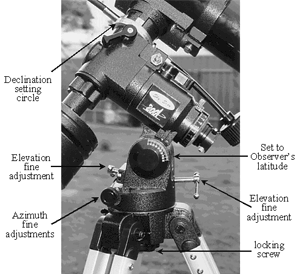 The inclination of the polar axis on the telescope mount should first be set to the latitude of the observer (Figure 1). For Adelaide this is close to 35° and the mount can be left set to this value if you are only observing in and around Adelaide.
 -
Next the telescope mount (usually a tripod) should be set down so that the polar axis is pointing approximately at the SCP. A popular way of locating the approximate position of the SCP is to draw an imaginary line through the long axis of the Southern Cross (Crux) and a second line bisecting, and at right angles, to the line joining the two pointers (aand bCentauri). These two lines meet at a point close to the SCP. Care should be taken during this stage to ensure that the azimuth and elevation fine adjustments are in the middle of their ranges and that the equatorial head is level.3
-
Using a bright star, the finderscope should be adjusted so that it points accurately to where the telescope is looking. Again, you can transport the telescope with the finderscope attached and already accurately aligned.4
Alignment with the SCP
-
First set the declination setting circle to -90° (see Figure 1).
-
Next back off the azimuth fine adjustment screws and loosen the screw underneath the equatorial head so that it can rotate in azimuth. Pan east and west until you recognise the stars in Figure 2.
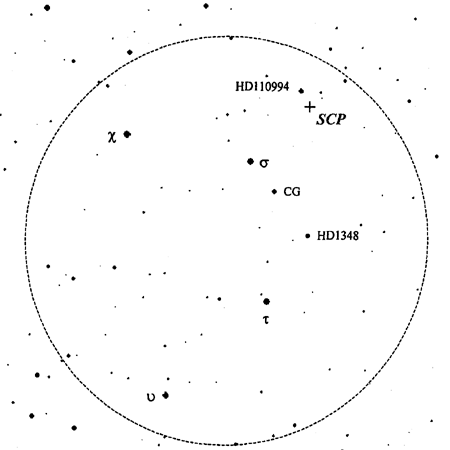 Figure 2: Stars near the SCP
The dashed circle represents a field of view of about 5°
The four stars,s,t,uandxOct, are just visible to the naked eye and form a quadrilateral that fits in a 5° field of view. CG Oct and HD 1348 are seventh magnitude stars forming a line withsOct. This pattern is quite distinct. The seventh magnitude star HD 110994 is about a degree away fromsOct and currently close to the SCP.
-
Now use the fine adjustments controls in elevation and azimuth to adjust the equatorial mount until the finderscope is pointing to the position marked on Figure 2 and tighten up the screw underneath the equatorial head.
This method depends upon the declination axis being at right angles to the right ascension axis and the declination scale being accurately attached.
These conditions appear to be met sufficiently well for satisfactory alignment of my EQ3 mount. With practice the method can be carried out quickly, the key to this being recognising the pattern of stars in Figure 2.
Fine Adjustment for Aligning the SCP - The Drift Method
Using this method, azimuth and altitude are adjusted separately until the effects of star drift are eliminated.
- Azimuth adjustment
Select a star on the celestial equator and meridian (i.e., Hour Angle = 0° and Dec. = 0°). -
- If, over time, the star drifts S in the eyepiece then the southern end of the polar axis is pointing East of the SCP.
- If the star drifts N then the southern end of the polar axis is pointing West of the SCP.
- Altitude adjustment
Select a star in the East (and/or in the West) low on the horizon and in the southern hemisphere of the sky (e.g., ~ Hour Angle = 4 to 5 and Dec. ~ -45º). -
- If the star in the East drifts N the elevation is too low.
- If the star drifts S the elevation is too high.
- This is reversed for a star in the West.
1 Details of these methods are available on request.
2 The popular EQ series of equatorial mounts have such adjustments (see Figure 1).
3 The EQ mounts have a bubble level built into them. Otherwise you can buy a bubble level from a local hardware store for a few dollars.
4 The finder-scope should have good quality optics and about a 5° field of view.