A Tale of Discovery
Justin Tilbrook, one of our more experienced variable star observers, was not searching for comets. He just happened to be looking in the right direction at the right time, and was familiar with the starfield.
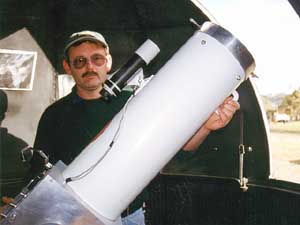
Justin was observing the dwarf nova TV Corvi on the evening of July 22nd (local time), when he noticed a nearby 10th magnitude blob about 60-70 arcseconds in diameter. Not having seen it before, he took note of its position (1997 Jul 22 10:20 UT 12h18m23s -18d59' (2000)) using the VSS RASNZ chart for TV Crv. A second look at 11:54 UT showed the blob had moved (12h18m25s -18d55'), so Justin began phoning other observers for verification.
As luck would have it, everyone locally was clouded out; but we were able to confirm that no known galaxies, nebulae or comets were in the vicinity. An e-mail was then sent to the Central Bureau for Astronomical Telegrams.
IAU Circular 6705 announced the discovery on July 23. A preliminary orbit announced in IAUC 6707 showed the comet was close to perihelion at about 1.4AU from the Sun and a similar distance from the Earth. At the time of discovery the orbital plane was almost at 90d to our line of sight.
If the comet had been 3 months earlier, it would have been visible in 7x50 binoculars from the Earth.
Extrapolating the orbit backwards a few months helps explain why this comet wasn't found earlier. Although it has been over 60 degrees away from the Sun since March, it has spent most of the time cruising through Carina, Vela, and Centaurus - constellations with an abundance of stars, clusters, and nebulae.
Comet Tilbrook finally escaped the Milky Way in late June, but because it happened to be winter in the Southern Hemisphere the weather had been poor. In fact, the night of discovery was the first semi-clear night Justin had for two weeks.
Justin Tilbrook lives on a dark hillside in the Clare Valley district of South Australia. The Clare Valley is a bit of a magnet for visiting amateur astronomers; although it isn't clear if the attraction is the dark skies, the many excellent wineries, or both!
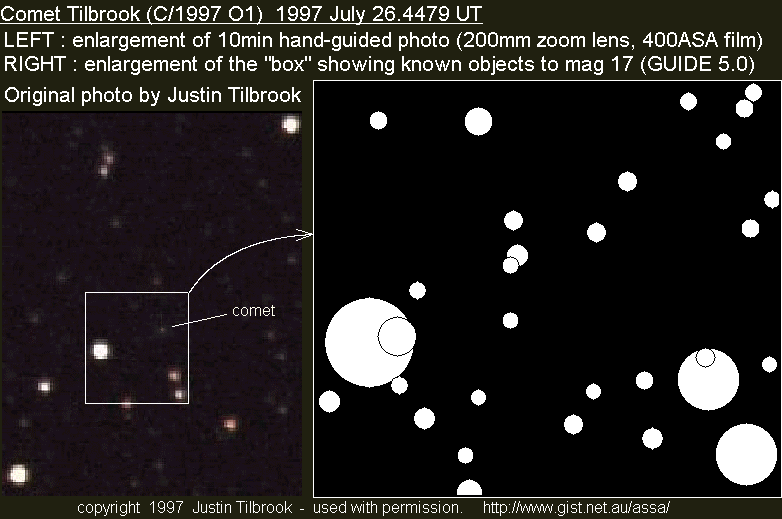
You can download a photograph of C/1997 O1 taken by Justin, using a 35mm camera with a 200mm zoom lens and 400ASA Fujicolor print film; on the evening of 1997 July 26 (10:45 UT). The camera was hand-guided for an exposure lasting 10 minutes, to capture this faint image of Comet Tilbrook. As can be seen from the included star chart, no known comets, galaxies, nebulae or other fuzzy-looking objects were nearby.
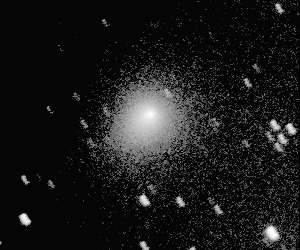
C/1997 O1 was Justin's first comet discovery. The majority of comets are found during deliberate searches by dedicated comet hunters - an activity Justin now pursues successfully. The first Comet Tilbrook (C/1997 O1) joins Comet Williams (C/1998 P1), Comet Kaho-Kozik-Lis (1936III) and Comet Jones (1946VI) as one of the rare and accidental discoveries of comets - by variable star observers - in a variable star's vicinity.
Tilbrook Strikes Again!
This time, Justin Tilbrook was actually comet hunting when he found a 10th magnitude arcminute-sized blob heading southwards; on the evening of 1999 January 12 (Jan 12.486UT). He found it at 23h38m -28.1d (2000), in a barren piece of sky on the Aquarius-Sculptor border.
Justin - armed with ephemerides of all visible comets - was sure it wasn't a known comet; and he could not recall seeing any uncharted galaxies (or similar fuzzies) during previous searches of this area. Two Australian astrometrists (Gordon Garradd and Frank Zoltowski) were then contacted to provide confirmation and precise positions. Then the observations were e-mailed to the Central Bureau for Astronomical Telegrams for checking.
At this stage, it was still possible that this object was a very faint known comet (not in Justin's ephemerides) that had brightened dramatically - or that it had just been discovered and reported by someone else. Fortunately, Justin's anxious wait was ended on January 13 by IAU Circular 7084, announcing the discovery of C/1999 A1 (Comet Tilbrook).
The revised parabolic orbit from MPC 33651 is:
- T = 1999 Jan 29.5750 (the time of perihelion)
- q = 0.731240 AU (the perihelion distance, 109.4 million km)
- peri = 232.5353 degrees
- node = 259.0986 degrees
- i = 89.5607 degrees
Below is a composite of 3 unfiltered CCD images taken at Stockport Observatory, shortly before midnight (local time) on January 14. The observers were Jim Costello, Trish Ellin and Rob Purvinskis.
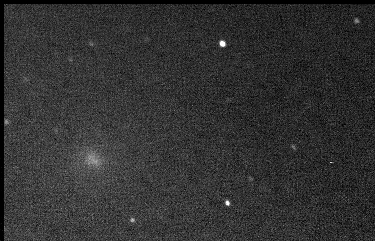
Although each exposure was only 15 seconds, they span about 5 minutes of time in total - so the comet image is slightly trailed. No tail was seen.