General Meeting: April 2026
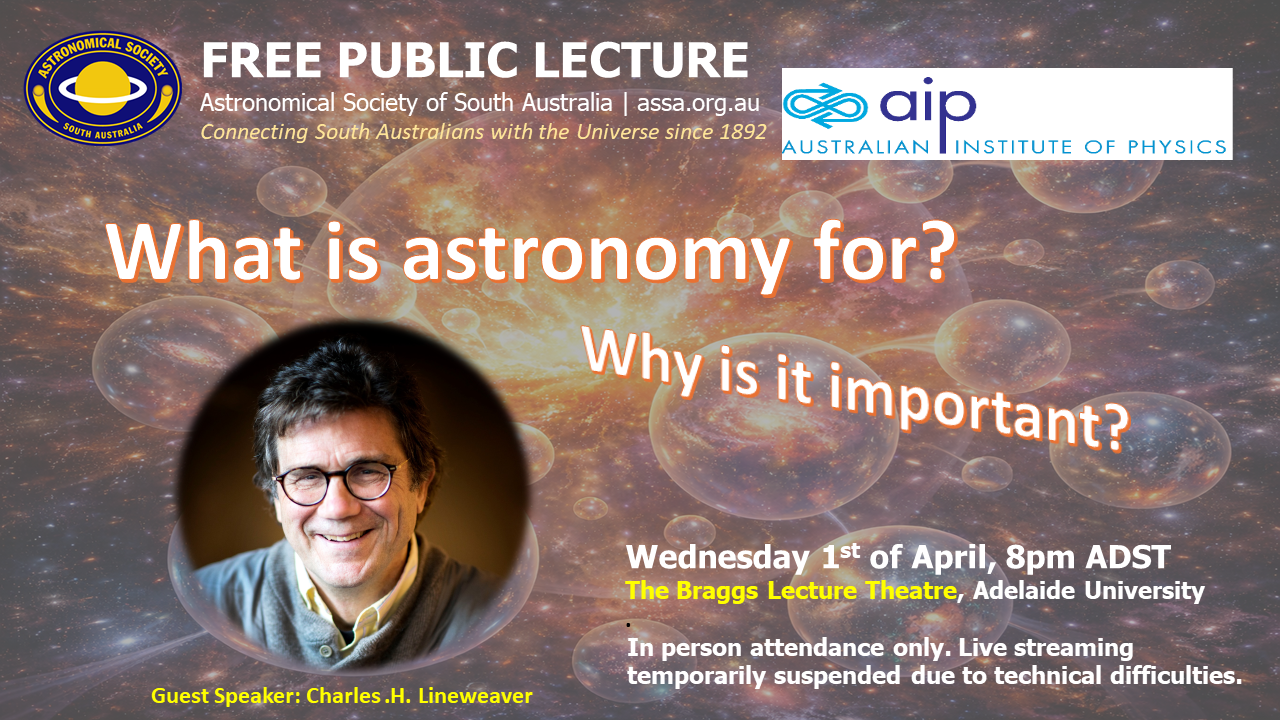
ASSA monthly meetings are held in-person and are open to the general public.
Due to the University's new AV setup, it is no longer possible to stream these sessions.
Attend In-Person: This is a free public event. A theatre ticket is NOT required for this meeting. Just roll up.
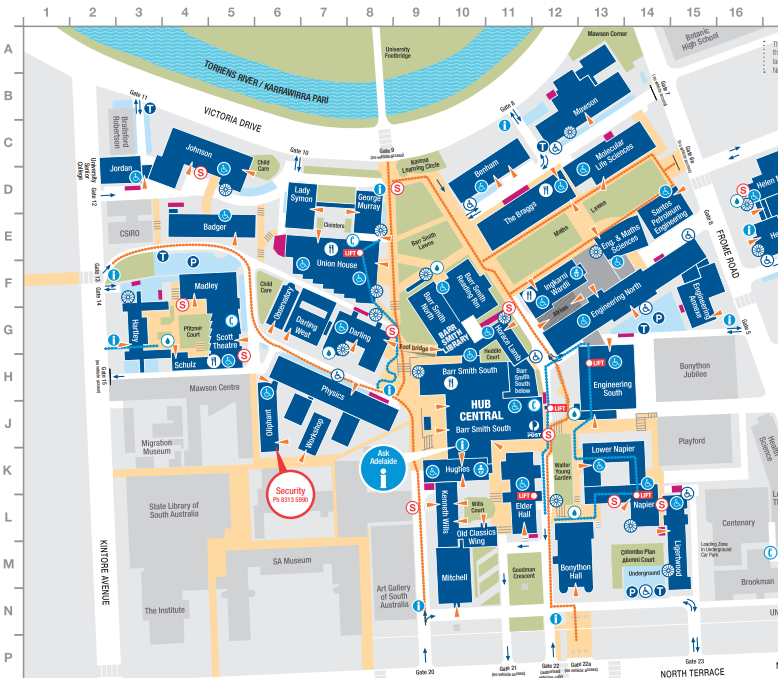
Finding the Venue: The Braggs LT entrance faces the Barr Smith Lawns and is located at E10 on the map.
Meeting Agenda:
- General Meeting
-
Charles H. Lineweaver - What is astronomy for? Why is it important?
- Announcements & Upcoming Events
- Close at 9:30pm
Speaker: Charles H. Lineweaver
Abstract: The best way to understand something is to find out how it got here. Where did it come from? What are its origins? This is true for families, nations and astronomy. All human cultures have painted their ancestors and myths onto the night sky. When something is that universal, there must be adaptive reasons for it. The desire to know where you are on the most comprehensive map you can make, has probably helped us survive (but we'll see what happens when we find ET?). I will describe the history and future of how the universe just keeps getting bigger and bigger why that's important; more planets, more stars, more galaxies and even more universes!
Bio: Astrobiologist, Charles H. Lineweaver is an honorary associate professor at the Australian National University’s Research School of Astronomy and Astrophysics. He has taught astronomy, planetary science and astrobiology for more than 20 years. His research areas include exoplanetology (the statistical analysis of exoplanets and their habitability), cosmobiology (using our new knowledge of cosmology to constrain life in the Universe) and cancer (a new atavistic model). He recently completed an online video course “Are We Alone?...well…How did WE get here” at: arewealone.us. Dr. Lineweaver earned a BA in history from the State University of New York at Binghamton, an MA in English from Brown University, a BS is physics from Ludwig Maximillian's University in Munich, and a PhD in physics at the University of California, Berkeley in 1994. His PhD supervisor, George Smoot, received the 2006 Nobel Prize in Physics for their discovery of fluctuations in the cosmic microwave background radiation. He has lived in Paris and Strasbourg, France (5 years), Munich, Germany (3 years), Kyoto, Japan (3 years), Ile-Ile, Nigeria (1 year) and Alexandria, Egypt (1 year). He is the son of a high school biology teacher and has lived in or travelled through 85 countries, has spoken 4 languages semi-fluently at one time or another, and was a semi-professional soccer player in New England and Germany.
Event info
Wednesday 01 Apr 2026
8:00 PM - 9:30 PM
The Braggs Lecture Theatre (University of Adelaide) and Online