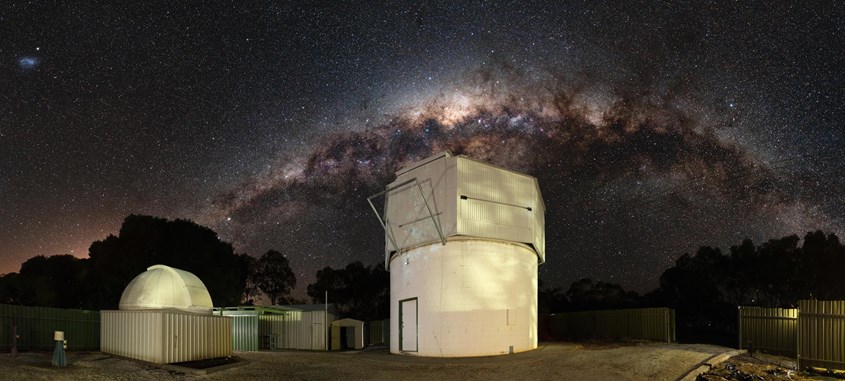
Stockport Observatory

Stockport Observatory domes

Stockport Observatory

Stockport Observatory is ASSA's primary dark-sky observing facility, located in the small town of Stockport, 6 km north-east of Hamley Bridge and approximately 80 km north of Adelaide.

The site provides a practical astronomical facility away from Adelaide's light pollution and is used for member observing, Society projects, public star parties, training and private group visits.

At a glance

Location Stockport, approximately 80 km north of Adelaide
Access ASSA member activities, scheduled public events and arranged group bookings
Best for Dark-sky observing, public outreach, member projects and telescope training
Facilities Permanent observatory domes, large telescopes, powered telescope pads, lecture shed, parking and basic amenities

Observatory facilities

The Society owns two large permanent observatories at Stockport. The Charles Todd Observatory houses the Society's largest telescope, the 20-inch (0.5 metre) Jubilee Telescope. The Jubilee Dome houses a 16-inch (40 cm) telescope, and the Grida Dome houses a 12-inch (30 cm) Schmidt-Cassegrain telescope.

The site also includes a 15-inch (38 cm) Newtonian reflecting telescope in a slide-off roof observatory, four powered telescope pads, a large shed seating around 30 people for lectures and slide shows, and an off-site car park.

Telescopes

  • The Jubilee Telescope is a 20-inch (0.5 metre) Newtonian-Cassegrain reflecting telescope built with assistance from the state's Jubilee 150 Board in 1986.
  • A 16-inch (40 cm) telescope is housed in the Jubilee Dome, built in 1986.
  • A computerised 12-inch (30 cm) Schmidt-Cassegrain telescope is housed in the Grida Dome.
  • A 15-inch (38 cm) Newtonian reflecting telescope is housed in a slide-off roof observatory.

The telescopes are used for Society projects and to show visitors the beauty of astronomical objects in the southern skies.

Image: The Charles Todd Dome and the Grida Dome at Stockport Observatory. Image credit Steven Saffi.

Public Viewing Nights

Star Parties for the public are usually held at Stockport Observatory in February (Summer), May (Autumn), August (Winter) and November (Spring). The dates for upcoming Star Parties are:

The current fees for Stockport public viewing/stargazing nights are: 

Adults: $15
Children aged 5 to 15:  $ 5
Children under 5 years:  Free
ASSA Members*: Free


Members are welcome to attend public viewing nights free of charge. Members must sign in on arrival and provide their membership number. Only members who are volunteering in an official capacity at public events need to be pre-approved and hold a current Working With Children Check.

For your safety and comfort, bookings are now required and attendee numbers are strictly limited. To avoid the disappointment of not being able to enter the observatory if we have reached capacity, attendees must pre-purchase tickets online by selecting one of the dates. Note that if you are unable to attend, you are able to cancel pre-purchased with the full amount refunded at any time before the event.

On public viewing nights, tea, coffee, biscuits, sausage sizzle and cold drinks can be purchased.

Viewing nights may be cancelled if the weather is unsuitable. If in doubt, confirm by visiting our website before travelling to any observing session. Should the event be cancelled, pre-purchased tickets will be refunded in full.

How to Get to Stockport Observatory

  1. Drive north towards Gawler, taking the bypass around the town and then follow the A32 towards Tarlee.
  2. To remain on a Sealed Road: On the A32, about 600m after the Templers 80 km/hour sign, turn left at the Hamley Bridge/Balaklava sign and drive towards Hamley Bridge. A white "street" sign within Hamley Bridge will direct you to Stockport. Follow the sealed road all the way into Stockport.
  3. Caution -- Unsealed Road: GPS navigation systems may direct you past the Hamley Bridge / Balaklava turn off on the A32, requiring you to turn off further ahead on the A32 and to then drive on an unsealed road to reach Stockport. Please decide your driving preference ahead of time.
  4. In Stockport, cross the bridge and turn left onto Observatory Road -- look out for the domes!

Unfortunately there is no public transport to Stockport.

A Google Earth map is below, alternatively you can download a printable map (PDF).

Parking

There is a small car park at the observatory and ample parking on Observatory Road if the car park is full.

What to Wear & Bring

It can get extremely cold at Stockport, both in winter and summer. This isn't helped by the fact that you will be relatively immobile during the night!

If you are travelling to Stockport, we recommend that you bring:

  • Jumper and a warm jacket. Wear more layers of clothes than you think you will need. If you get too warm, you can always take them off.
  • A pair of gloves.
  • A beanie.
  • Enclosed shoes -- for your safety & comfort
  • Insect repellent -- mosquitoes can make for a very unpleasant observing experience, particularly at dusk!

White light from torches is not permitted during viewing nights. White light affects the ability for your eyes (and everybody else's) to dark adapt. If you want to bring a torch, please ensure that it is covered with a red filter (such as red cellophane).

Private Bookings

Private evenings can be booked at Stockport Observatory for your school, club or group, or for special occasions. Booking fees vary depending on the number attending and the requirements of the group. Visits may be any day of the week by prior appointment.

The best time to plan your booking is usually around a first quarter moon. This will allow us to show you the moon through a telescope, and some of the other brighter objects in the night sky. If you prefer a dark sky to observe fainter objects (such as galaxies and faint nebulae), then new moon or last quarter moon are preferred. Observing near full moon is not recommended because the brightness of the moon makes it difficult to see many of the fainter objects in the night sky.

The following fees are charged for private bookings at Stockport Observatory:

  • For schools, Scout groups, or other educational organisations: 
    $250 booking fee, plus $12.50 per child over 10 children
     
  • For all other private bookings: 
    $500 booking fee, plus $25 per person over 10 people

For more information or to arrange bookings for observatory visits, please e-mail observatories@assa.org.au or telephone the Observatories Director on (08) 8391 5377.

Stockport history

Stockport Observatory at 40: A Chronicle from the ASSA Bulletin (1984–2025)

From dark skies to light domes, and back again

This article is published to commemorate the 40th anniversary of Stockport Observatory, a facility that has been planned, funded, built, operated, repaired, and debated in public view through the ASSA Bulletin record since the idea first appears there in 1984. It was written after reviewing more than 40 years of Bulletin material, then following the thread forward from proposal to fundraising, to an opening in 1986, through decades of member nights and public nights, major upgrades and rebuilds, and into the present discussion about light pollution and long-term options.

Stockport history sections

Historical material from the ASSA Bulletin record is arranged by topic below.

The idea appears in print: 1984, then a campaign

Stockport’s history in the Bulletin begins in May 1984, when a notice of motion proposed allowing the Stockport Observatory subcommittee to spend $6,000 towards establishing an observatory at Stockport, north of Adelaide. Within months, the Bulletin shifted from concept to fundraising. In July 1984, a Bulletin report described an official launch of the Stockport fund-raising campaign at a dinner, and reported a target project requirement of $35,000. By January 1985, the Bulletin named Joe Grida as chairman of the Observatory fund-raising committee.

By late 1985, the Bulletin record shows external support arriving alongside member effort. A November 1985 Stockport progress report recorded an additional $8,000 grant made available through the Jubilee 150 Board, bringing total Jubilee 150 funding to $28,000, and it also noted sponsorship of materials.

Funding was not only a question of grants and sponsorship, it also involved members stepping in to meet specific needs when they arose. A February 1986 Bulletin report described a push to raise funds through member loans to purchase a transportable building. The target was $5,000 and the amount raised was $5,050, and the report stated that the building had been purchased, with work underway to add plumbing and hot water services.

By March 1986, the Bulletin reflected a project moving into completion, with Joe Grida writing that the Society was within days of the official opening and noting how much had been achieved since the first meeting two years earlier. In April 1986, a Bulletin caption recorded that Ian Bedford had donated land at Stockport and that the observatory was officially opened by Don Hopgood, Deputy Premier, who had supported the Society through Jubilee 150.

Stockport Observatory history imageStockport Observatory history image
Ian Bedford (right) donated land for the observatory and is shown receiving a certificate of merit from Joe Grida (left).

Don Hopgood, Deputy Premier, officially opened the observatory after supporting Jubilee 150 funding for the project. The Bulletin, April 1986

Opening into demand: 1986 to 1989

By October 1986, the Bulletin reported that it was six months since Stockport’s opening on 8 March 1986 and described heavy demand, including the observatory being fully booked for September to November. It also reported that over 3,000 people had visited in the first six months. In January 1987, the Bulletin reported that the total since opening had risen to over 4,000 visitors.

Routine operations appear in the late 1980s as a steady cadence of member nights and public open nights, reported in short practical summaries. The Bulletins also show Stockport becoming a venue for more structured programmes, including themed events such as “Marsgaze ’88”, a weekend timed to Mars’ close approach that combined camping, astrophotography workshops, and practical Mars observing and imaging using the 20-inch (0.5 m) Jubilee Telescope.

In the same period, Starfest appears as Stockport’s “star party” weekend. In 1986 it was pitched as a local version of major US gatherings (Texas Star Party, Riverside, Stellafane), enabled by Stockport’s country site and nearby camping, with the first event planned for the October long weekend and an aim to repeat it annually. Early programme notes show it was designed as more than observing, adding talks and workshops, a Trash and Treasure market, competitions, and a formal dinner. By 1988 it had expanded to include a “Winter Starfest”, plus adjacent tours such as Ian Bedford’s Starcastle Observatory.

Stockport Observatory history imageStockport Observatory history image

Lyn Rowell and Joe Grida admire the 20” Telescope. The 1.5 Ton instrument was designed by Society Member Ian Anderson and manufactured by John Walkley of Hawthorndene. Schematic drawing of the Stockport Observatory 500 mm f/5.20 telescope by Ian Anderson. The Bulletin, March 1986

The 1990s: keeping it usable, and watching the sky change

Through the 1990s, the Bulletin record shows two threads running in parallel. One is the ongoing work of improving day-to-day operability: practical changes that make public nights workable and reduce the effort required to run the site. The other is the environment around the observatory, particularly the gradual return of light-pollution pressure and the ordinary reality of variable seeing.

The July 1992 report provides a clear snapshot that links both threads. It noted Adelaide’s glow visible from Stockport, referenced changes to local street lighting, and recorded that the limiting magnitude had declined from about 6 at establishment to about 5.5 by 1992. It described seeing variation too, with very good nights alongside nights where seeing was only fair.

The Bulletins also capture practical adaptations aimed at keeping public nights worthwhile when the sky did not cooperate. Council approved the purchase of a VCR and monitor for Stockport, later described as “successfully used” on a public viewing night that was completely clouded out, allowing a video presentation to replace observing. Other entries focus on telescope upkeep and usability: long-standing dust issues and deterioration of the 20-inch (0.5 m) mirror led to recoating, along with the fitting of a plastic shield to reduce dust settling on the mirror. Dewing was another recurring issue, with reports noting that water could still be found on the mirror the next day and that hot air from a hair dryer was sometimes used as a practical workaround.

Beyond ongoing maintenance, the 1990s record also shows Stockport being treated as an asset that needed long-term security. In October 1993, the Bulletin reported that Ian Bedford intended to move his telescope to Riverton and that the possibility of the Stockport property being sold was being discussed, with Council forming a committee to consider alternatives, including relocation. Shortly after, an offer was tabled for the Society to purchase the Stockport site for $15,000, with Council listing advantages and disadvantages of staying or relocating, including neighbour lights and Adelaide’s glow as disadvantages.

A December 1994 financial report then recorded that Council recommended, and a Special General Meeting endorsed, the purchase of an adjoining parcel of land owned by Ian Bedford. This strengthened the Society’s position at Stockport and reduced exposure to external changes.

By 1996, the observatory had been operating long enough to mark its tenth anniversary as a Society event. Bulletin notices promoted a “10th Birthday Party” for Saturday 16 March 1996, with ASSA chartering a bus from the Unley Shopping Centre car park. The notices also emphasised the practical, communal scale of the night: acceptance slips were used to confirm BBQ catering, close to 100 acceptances were noted, and members who had not visited recently were encouraged to come and see the site improvements achieved through volunteer effort.

Stockport Observatory history image

The amenities building is lowered in position. In the background can be seen the dome of Ian Bedford’s Observatory.

The 2000s: larger-scale operations and moving major equipment

The Bulletin record for the 2000s shows Stockport operating as a busy, multi-purpose facility, with public nights and group bookings remaining strong and an ongoing push to broaden the trained volunteer base needed to run larger instruments reliably. Annual reporting around 2000–2001 notes regular activity, with bookings and public nights popular, alongside efforts to increase member use through formal telescope-operator training for the 20-inch (0.5 m) Jubilee Telescope.

By 2002 the decade’s scale was also visible in the logistics. The Bulletin describes a crane arriving to relocate the 20-inch (0.5 m) Jubilee Telescope into the Charles Todd Observatory, the 20-inch dome, with the new 18-inch also being moved into place. Late 2002 notices also show Stockport responding to event-driven demand, scheduling extra viewing nights around the 4 December 2002 total solar eclipse to cater for increased interstate and overseas visitors, and a January 2003 follow-up notes that while numbers were modest, the nights drew visitors from multiple countries.

In parallel, the Bulletins show the site becoming more visitor-ready in everyday ways, including the Jubilee telescope settling into its larger home and the creation of a “Star Cafe” area integrated with the BBQ and pergola space for pre- and mid-session breaks. By the mid-2000s, reports reflect Stockport running multiple large instruments for large crowds and continuing to invest in the infrastructure needed to do so. A May 2004 report notes that, for the first time, the 20-inch and 18-inch were used simultaneously for about 90 visitors, with the 20-inch operating successfully as a computerised GOTO scope.

From 2005 to 2006 the record shifts more clearly into infrastructure and capability upgrades. A January 2006 report summarises significant electrical and lighting improvements, including new switchboards with circuit breakers and earth-leakage protection, plus separate red and white circuits. It also describes extensive work to improve the 20-inch, including dome and shutter control upgrades and imaging support, and a slide shed upgrade to data projection and DVDs for nights when conditions prevented observing.

Late in the decade, the Bulletins also show more structured advanced-user engagement and continued public demand. Council approved the Stockport 20 Users Group for advanced imaging users, partly to share workload and trial techniques relevant to the long-running 36-inch South Australia Telescope project, a proposed research-grade instrument whose design work and mirror grinding progressed intermittently while its funding and final site remained unresolved. By 2009, large-event demand is still evident, with a Summer Star Party report noting 197 tickets sold and a net profit despite poor conditions, another indicator that Stockport’s outreach programme was operating at substantial scale.

Stockport Observatory history image

The dome is gently lowered onto the observatory building. A TV cameraman captured the scene.

The 2010s: flood damage, dome failure, shutdown, funding, rebuild, reopening

A major turning point in the Bulletin record comes with the December 2010 storms and flash flooding that hit the township of Stockport. Bulletin reporting soon after recorded that the town was inundated on 8 December 2010 and that, while the observatory escaped the worst due to its elevation, it still suffered storm-related impacts.

The January 2011 Bulletin then documented the observatory-specific damage: driving rain exposed leaks in the 20-inch dome, water reached the viewing-platform floor, and several sections were deemed unsafe, leading to the dome being closed until a safety assessment and repairs could be completed.

A later President’s report notes that, with residents displaced from their homes, the State Government established portable showers and toilets and a temporary laundromat on the observatory site, and that ASSA allowed residents access to the observatory’s showers and toilets for several months.

By mid-2011, the Bulletin’s focus shifted from repair to replacement. An August 2011 notice states that the December 2010 storm highlighted multiple leaks and water damage to the viewing floor, and that Council was working towards replacing the Charles Todd Observatory dome, seeking member approval to commit up to $10,000 for design and project-planning work. In September 2011, the President reported that the dome’s deteriorating condition had forced Council to suspend any activity involving rotating the dome or opening the shutters, and explicitly linked the dome shutdown to outreach, school and public groups, and Star Parties, noting these activities brought in about $6,000 annually.

In early 2012 the Bulletin tied the continuing shutdown to the broader wet cycle. The January 2012 report stated that the La Niña event had made viewing difficult and that rain had exacerbated the dome problems, with multiple engineers and the local council building inspector recommending the shutter remain closed and the dome not be rotated. It also records the scale of remedial work underway, including replacement of a floor “severely water damaged in the storms of late 2010”, ongoing termite eradication, repairs, and general maintenance, while noting the replacement dome was unlikely before mid to late 2012.

To maintain outreach and member use during the 20-inch dome outage, the December 2011 Bulletin reports installation of a new 12-inch Meade LX200 in the Jubilee Dome, explicitly positioned as a computerised telescope for members and public viewing while the 20-inch remained out of commission pending the dome replacement. Funding and approvals then appear as a longer runway than early optimism suggested: a February 2014 Bulletin note states ASSA had secured a $50,000 grant for the major part of the new construction, with an expectation the new dome would be operational before July 2014. A March 2014 progress report describes waiting on final local council approval and preparing to contract for fabrication, removal of the old dome, and installation of the new framework.

The reopening milestone arrives in 2016. The April 2016 Bulletin records the new turret over the Charles Todd Observatory opening on 5 March 2016, after years of work and planning, and credits key contributors to the Dome Replacement Project while noting the project moving into an automation phase. Later that year, a Spring Star Party report describes about 130 members and public attending, and again shows the Stockport pattern of maintenance and outreach overlapping, with helpers arriving early for a working bee alongside slideshows and imaging demonstrations.

Stockport Observatory history imageStockport Observatory history image

Official Opening of the new turret on 5 March 2016. Mr Geoff Brock, Minister for Regional Development and Local Government (Left) & Joe Grida, ASSA President (Right). An aerial view of the Stockport site, showing the new turret and the old dome on the observatory building. The Bulletin, March 2015

Stockport in the 2020s: pandemic and ongoing practical issues

The 2020s Bulletins capture how abruptly operations changed during the COVID-19 period. A July and August 2020 “limited use” notice restricted access to observation pads and toilets only, with buildings and domes closed and Society instruments locked down. Members were required to bring their own telescopes and supplies, with shared kitchen and BBQ facilities not to be used, and access controlled via permission from the Facilities Director, including attendee lists, a nominated duty officer, strict hygiene requirements, and limits such as three observers per pad. In 2021, Bulletins show a gradual, controlled return of member nights under conditions such as sign-in and QR check-in where possible, no sharing of equipment, and no BBQ facilities.

In late 2024, Stockport’s monitoring capability took a step beyond connectivity into continuous, measurable sky intelligence. A February 2025 Bulletin report notes the AllSky Camera Project advanced in early December 2024 when Blair Lade and Paul Haese installed an all-sky camera, cloud sensor and SQM at Stockport, with the system reported as fully working. Now integrated into the ASSA website, the system can push images and video to members, turning Stockport into a live site where members can check cloud and darkness conditions before committing to a drive for observing or imaging.

The same report links this work directly to long-term light pollution tracking, noting that Andrew Cool and Ken Grant have been analysing 6 to 7 years of SQM data from Meldanda and have developed a statistical method to represent sky darkness, with the explicit aim of applying that method to Stockport to quantify the effect of encroaching light pollution over time.

Some 2020s reports also document persistent practical problems. One is birds, which a September 2020 working bee report described as “still having a party inside the turret” during the day-to-day closure of the observatory under COVID-19 restrictions. It adds that birds had been an issue “ever since we built the turret”, apparently because they treat the turret height as a natural roosting place. The report notes that even after a shock-track was installed on the shutter, birds still managed to enter, with careful observation suggesting they were burrowing through the brushes at the bottom of the turret. As a response, Paul Haese and David Jenke installed flashing under the brushes to close the gap they were using, and the Bulletin invited members to share any further ideas for stopping the “feathered intruders”.

Stockport Observatory history image

After receiving a coat of white paint, the dome was transported to Stockport.

The next decision: light pollution returns as the long-term driver

In June 2025, the Bulletin framed Stockport’s future as a subject requiring active planning, linking the discussion to South Australian Government plans to expand Adelaide’s urban growth boundary, particularly north of Adelaide, and noting that such discussions “invariably turn to relocation of Stockport.” The extract set out what relocation questions would need to consider, including member services and outreach objectives, and contrasted Stockport’s serviced model with darker but less serviced alternatives such as a site within the River Murray International Dark Sky Reserve. It also noted that any relocation case would require a fully costed plan, land acquisition, development costs, accessibility standards, timeline milestones, and an approach achievable within a volunteer base.

Seen across four decades, the Bulletin record shows Stockport as a member-built facility that has been continually reworked to stay useful: funded and constructed through volunteer effort and grants, run at scale for public outreach, protected and expanded through land and infrastructure decisions, and rebuilt after severe weather and structural failure. The same record shows the original problem returning in a new form, with light pollution again shaping what Stockport can offer and prompting planning about long-term options. At forty, Stockport’s history reads as a repeating pattern of practical response: define what the observatory must provide for members and the public, then adapt the site, the equipment, and the operating model to deliver it under changing skies.